'The horrific episode of January 18 in Muzaffarpur, Bihar, is quite different from what happened in Muzaffarnagar, UP, in September 2013. The Akhilesh Yadav-led administration in UP and riot-mongers among our political formations need to learn lessons from the response of the state and society in Bihar's Muzaffarpur,' says Mohammad Sajjad.
'This time, even the professedly secular parties have maintained a conscious distance from being identified with Muslims.' 'This could be interpreted as a success of the BJP campaign of what it has been calling 'minority appeasement', says Mohammad Sajjad.

The longest-serving chief minister of any Hindi- speaking state, Nitish Kumar seems to have acquired an aura of indispensability when it comes to the highest seat of power in Bihar.

Pandey, who stepped down as the state police chief less than a week ago, however, insisted that he had walked down to the state headquarters of the Janata Dal-United, headed by the chief minister, to "thank" Kumar for the trust reposed in him by the latter.

These Muslim women are poor and illiterate but, with the devotion they display as they create handmade earthen stoves for Chhath, they strengthen the social fabric, says M I Khan.
'Compared to other social groups, managing the Muslim constituency has always been easier for the secularists.' 'Just some symbolic measures and window-dressing would keep the Muslim flock together.' 'Having been betrayed by all the supposedly 'secular' political parties, Muslims should turn into citizens without any ascriptive identity marks,'says Mohammad Sajjad.

'The mobilisation is nothing but a political ploy -- a sort of a fixed match between Hindu and Muslim communal forces, towards polarisation, in a run-up to the next election,' argues Mohammad Sajjad.

The future challenger to Narendra Modi would be somebody who can bring the Hindus and Muslims together again. The Hindus as Hindus, not broken caste groups, asserts Shekhar Gupta.

'Maybe the BJP believes, in the post-poll scenario, it will have the might to foist, anybody endorsed by the RSS, upon Bihar,' observes Mohammad Sajjad.

Mohammad Sajjad raises important questions about the response to lynchings.
'In Bihar, the Dalits are not a consolidated socio-political constituency,' says Mohammad Sajjad.

Kumar will always be known as the reformer chief minister who brought governance back to Bihar.
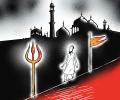
'Indian nationhood is indeed at the cusp of alarming redefinition -- hate-filled, and exclusionary.' 'Nations are not built this way, instead these are the ways of liquidating nations.' 'We must pre-empt it.' 'Can we?' asks Mohammad Sajjad.
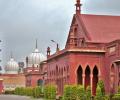
'The brazen politics, in this series of bullying of AMU by functionaries of the Union and provincial governments, utterly disregarding the fact that the matter is sub judice, is quite obvious.' 'One needs to see through the desperate politics of the BJP which governs both Uttar Pradesh and the Centre, especially its woes over its Dalit support base,' says AMU Professor Mohammad Sajjad.

What does one deduce from this silence? That the minorities in the BJP era have been muted, perhaps even coercively, asks Sajad Ahmad Dar.

Nitish Kumar is on the brink of taking another wrong turn. It is hard to fathom why he would tie up with the Congress, which has little political capital left in Bihar. Aditi Phadnis reports
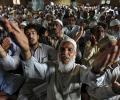
'The Ulema have come out as villains against Indian secularism, impeding the secular united resistance against violent Hindutva that is backed by ministers in the government,' says Mohammad Sajjad.
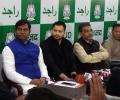
'The Mallahs may remain divided between the two competing coalitions in Bihar,' says Mohammad Sajjad.

The 'secularists'are more adept at the politics of intense and alarmingly exaggerated fear-mongering, as this kind of politics provides easy votes of Muslims without making them answerable for the concrete issues of poverty, unemployment, lawlessness, and of basic needs like roads, electricity, etc, which is exactly how Nitish Kumar was defeated in the elections, says Mohammad Sajjad.
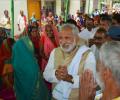
'It is the RJD, otherwise known for misgovernance, which has offered a candidate of clean and performing credentials, rather than the NDA,' points out Mohammad Sajjad.

'It is precisely because of the apprehensions about Lalu's revival that the upper castes have started re-thinking their electoral preferences. Out of confusion, they are simply deciding to vote for winnable candidates from their respective castes of any of the three parties -- the BJP, JD-U or RJD. This is what has considerably neutralised the NaMo wave in Bihar and resulted in Nitin Gadkari's remark that "Caste is in the DNA of Biharis". This is why Giriraj Singh, the BJP candidate from Nawada, made provocative statements,' says Mohammad Sajjad.
.jpg)
Nitish Kumar has spotted a secular trend in Bihar and with the minority's support he could trump Lalu Prasad, says Aditi Phadnis

'Nitish is now a helpless junior ally of Hindutva.' 'He just cannot think of reining in the hoodlums raging, marauding and killing in the mohallas,' argues Mohammad Sajjad.
 © 2026 Rediff.com - Advertise with us - Disclaimer - Privacy Policy - Sitemap - Feedback - About us - Terms of use - Grievances